

Let's play: "False rape accusation"
Privileged men accused of rape exploit public sentiment shaped by… privileged men accused of rape.

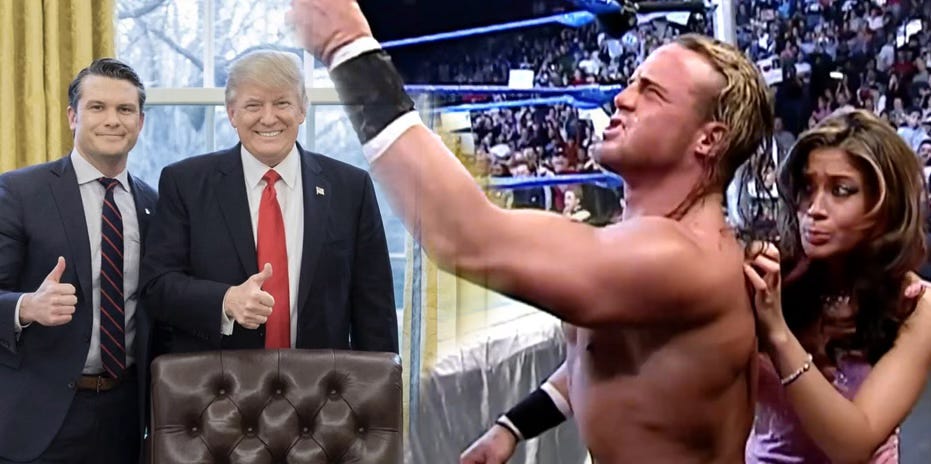
She instigated a sexual encounter in a men’s locker room. She knew a camera was rolling and that millions of people were watching.
And when she didn’t receive the career-advancing favor she expected in return, she hired a lawyer and publicly accused an innocent man of rape.
It was a WITCH HUNT! if ever there was one. And, judging by the screams of rage from the capacity crowd, millions of wrestling fans felt it to their very cores.
She lied to get my money
The requisite response of wealthy men facing sexual assault allegations is to accuse their accusers of fabricating the charge to extort them.
Fox News personality Pete Hegseth — President-elect Donald Trump’s nominee to lead the U.S. Department of Defense — has used this approach to explain the settlement he paid to a woman who told police that he raped her.
Hegseth is not the only nominee swatting down sexual misconduct accusers. And Trump himself has used the “she’s lying” defense against most of his 27 accusers — successfully in every case but one.
Americans tend to normalize and accept abuse of women when doing so comes with a political dividend. For a time, it looked like the #MeToo movement would change that. But in a recent YouGov poll, only 43% of Trump voters said allegations of sexual assault should be disqualifying for cabinet positions, while 45% said so for domestic violence. Why did #MeToo fail to reach vast swaths of our population?
While conducting research for my Wrestling Darkness podcast, I’ve learned of numerous World Wrestling Entertainment (WWE) storylines in which rape, sexual harassment, and abuse of women were dramatized in ways that may have served as a preemptive strike against #MeToo.
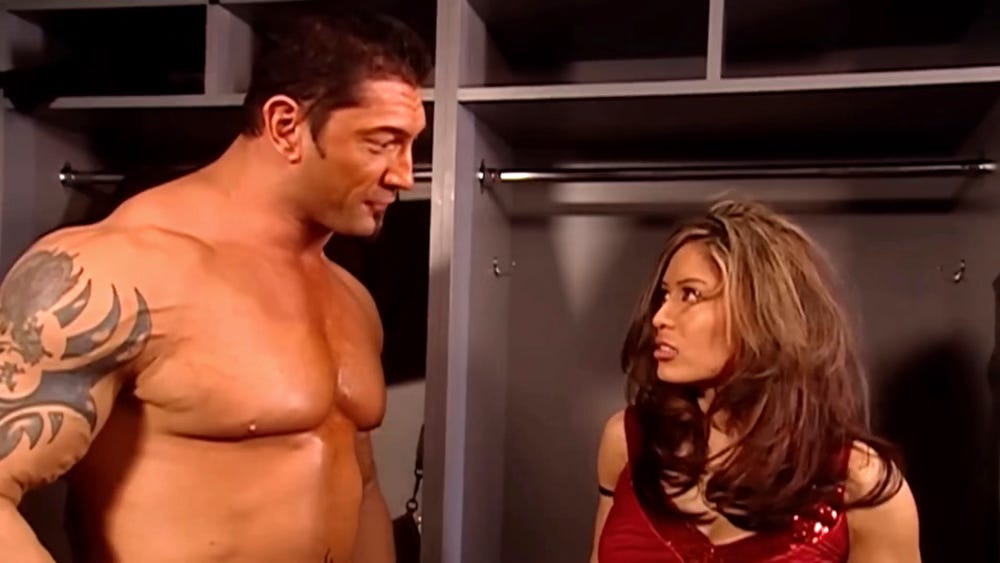
Some of the women are portrayed as willing participants who enjoy sexual harassment because they want to get ahead. Others fight back. Threatened with violence or sexual violence, they cry and protest. But in the end they are overpowered. They get body slammed or sexually assaulted anyway.
Usually, the women have done something to deserve it — she spilled a drink on me, she made me lose a match, she looked at another wrestler, etc.
An estimated 90 million Americans watch wrestling regularly, ⅔ of them men and boys. When WWE debuts on Netflix on January 6th, 2025, that audience will grow.
Along with the alarming cultural and public safety implications, there is also the ick factor that comes with the knowledge that WWE’s billionaire ringmaster, Vince McMahon, has been sued repeatedly by his employees for rape and sexual harassment dating back to the 1980s. The most recent suit alleges that he raped a female employee with sex toys he had named after his wrestlers. He is under criminal investigation for rape and sex trafficking (even though his wife, like Mr. Hegseth, is a cabinet nominee).
McMahon built his empire by staging violent soap operas that exploited America’s hatred of foreigners and gay men. This was considered par for the course at the time. Perhaps it generated some additional prejudice, but McMahon says his motive was making a profit, not spreading hate.
Could the same be said about the women-hating storylines, many of which featured McMahon himself as a tyrannical boss/sex offender? Was it a coincidence that these storylines began not long after the first known rape accusation by one of his employees?
Screaming is believing
WWE fans don’t just watch wrestling matches; they live them.
Wrestling spectators allow themselves to feel the emotions suggested for them by the performers. They feel them deeply enough to roar with ectacy, jump up and down, scream and shake their fists. Their voices send kinetic energy back to the performers. By engaging in this call and response, wrestling fans make possible the world’s most immersive, participatory brand of theater.
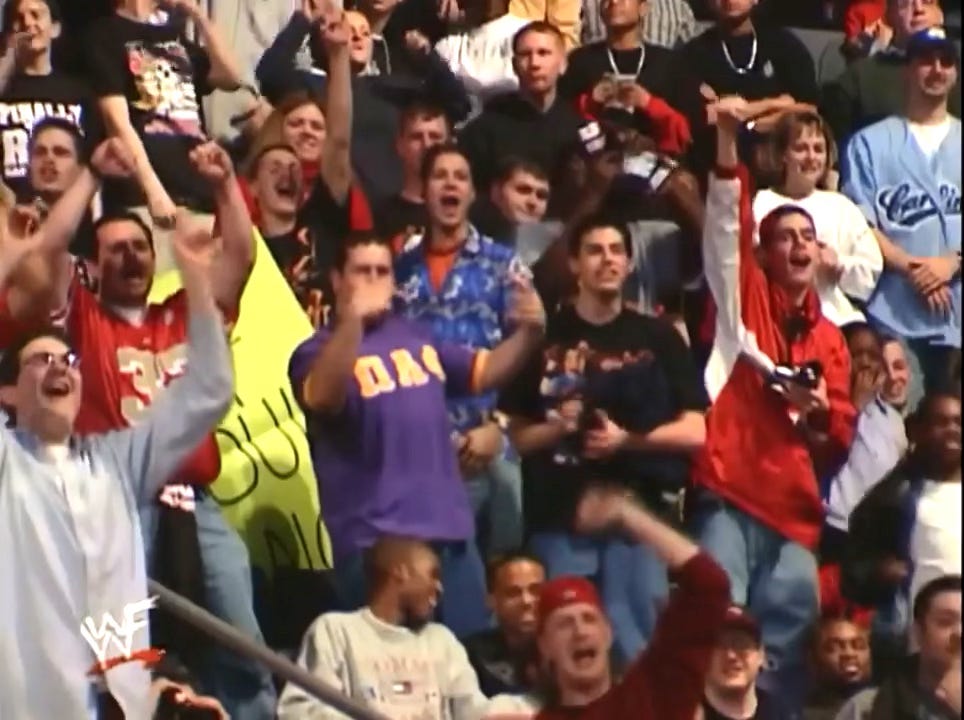
Without a mob of thousands, the ring acrobatics, the crackling oratory, the stomping on a giant drum each time a fist meets a face… everything the fans pay to see would be rendered ridiculous. And the millions watching at home? They feel love and hate, triumph and humiliation, not just through the wrestlers, but also through the fans performing with them.
Since the 1990s, wrestling shows have blurred the lines between fiction and reality even more by bringing cameras into the wrestlers’ sex lives. The non-wrestling scenes look a lot like reality TV.
Perhaps it is an unintentional byproduct, but pro wrestling as imagined by Vince McMahon has softened up millions of brains for things we might not otherwise have seen as permissible — including the physical, emotional, and sexual abuse of women, and, dismissing women who report sexual assault as fabricators.
He said, she said
The false rape allegations were lodged by Melina Perez, performing a version of herself with the same name, against Dave Bautista as the wrestler “Batista.” The story unfolded in episodes and live events starting in 2005.
Melina’s rape accusation generated a lot of “heat” as they say in the business. It filled arenas and pay-per-view coffers because fans were eager to see Batista avenge himself by fighting Melina’s stable of wrestlers, all of whom were gullible enough to believe her allegations and protect Melina from her supposed rapist.
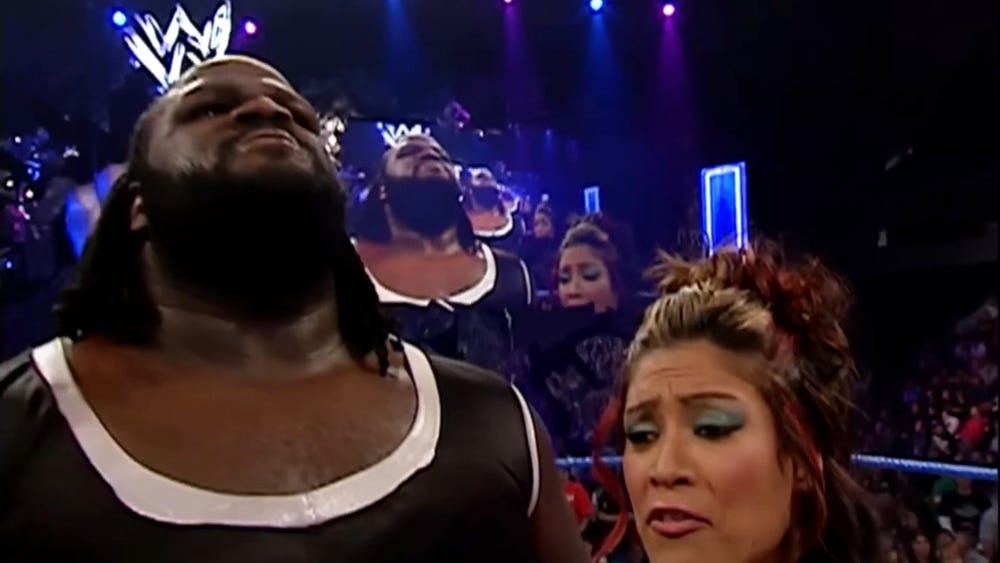
One such protector was an African American behemoth named Mark Henry. As a former Olympic weightlifter, his nickname had been “The Strongest Man in the World” until fans grew tired of seeing him in stars-and-stripes spandex. So, he donned black tights instead, suddenly rebranded as “Sexual Chocolate.”
Sexual Chocolate was shown in therapy sessions where he struggled to come to grips with incest and sex addiction, and in countless love scenes involving hot young women, a woman who was 48 years his senior, and a transvestite.
When Batista held a press conference to respond to the Melina’s charges, Sexual Chocolate burst through the door, walked up to Batista and said, “What if it was the other way around? What if it was me, taking advantage of you?”
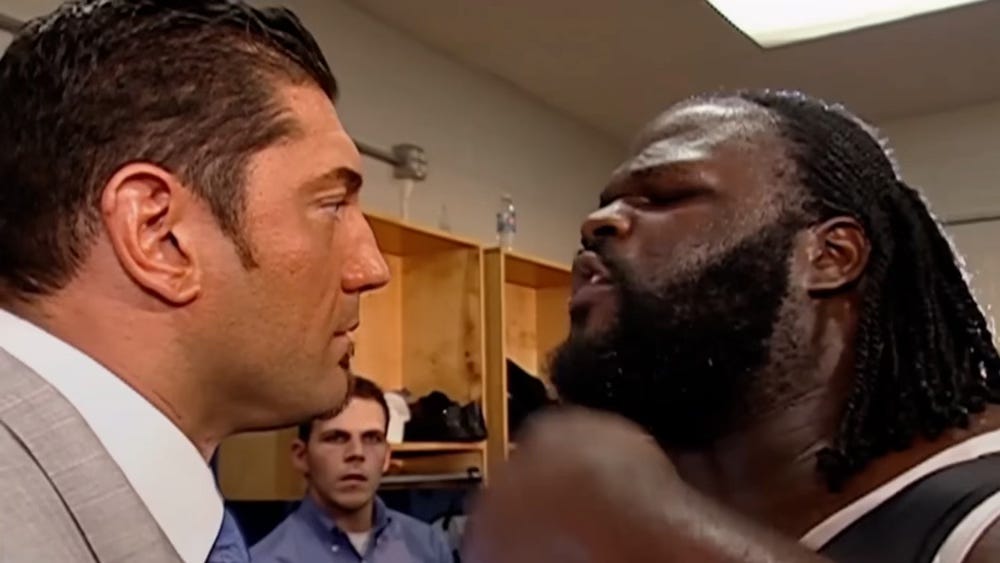
Thus the trifecta was completed. Lying women, hyper-sexual Blacks, with a sprinkle of homophobia all balled up together in one conspiratorial cabal to victimize the innocent and MeToo/woke the nation.
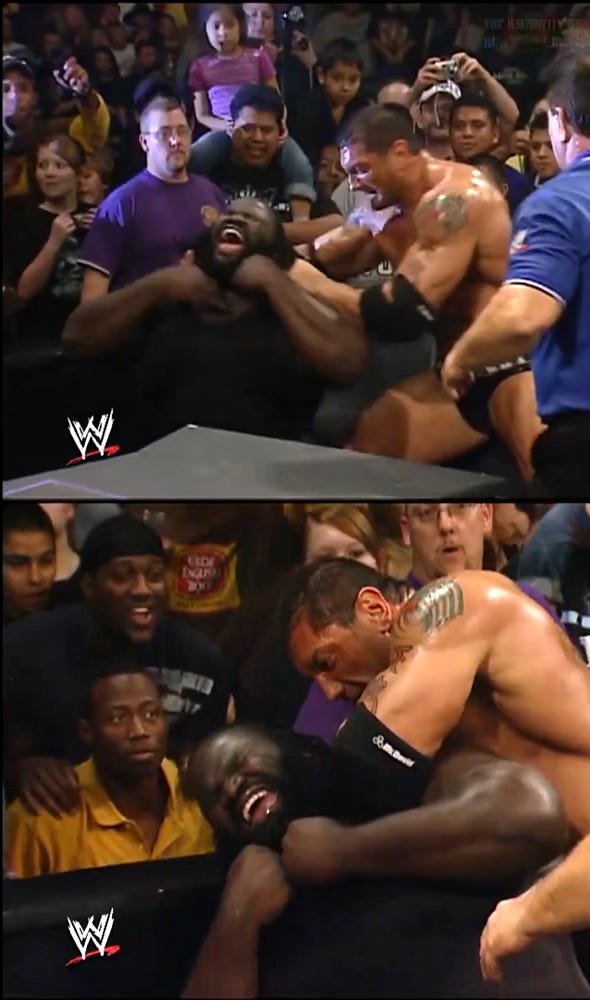
Batista was seriously injured in a subsequent brawl with his chocolate nemesis, which forced Batista to relinquish his championship belt. The storyline continued intermittently for two years until Batista ended the feud once and for all by mercilessly punishing Henry for his treachery, beating him repeatedly with a steel chair and choking him with an audio cable. The man who would later win our hearts in Guardians of the Galaxy portrayed himself as a warrior whose mind had snapped — a rabid beast filled with homicidal rage.
I am aware of one other storyline that explored the aftermath of sexual misconduct allegations. In that one, the accuser filed a real life harassment suit against McMahon. After settling out of court, she returned to WWE to play McMahon’s slinky sexpot girlfriend and the lawsuit was used as part of her backstory.
Otherwise, wrestling storylines that involve abuse of women teach us how, when, and why to begin abusing them in the first place — starting with what she did wrong.
Maybe McMahon’s goal as the showrunner was to use theater to respond to accusations that he was an abuser of women in real life. Or maybe he just wanted to build a global audience of men who enjoy seeing women brutalized and demeaned. Either way, these storylines did a very good job expressing, excusing, and encouraging hateful attitudes toward women.
Boys to men
I stumbled upon pro wrestling at the age of nine. It was a Sunday morning, you see, and Saturday morning cartoons only aired on Saturday. Within two episodes, I had turned all my Star Wars action figures into wrestlers.
Hulk Hogan, cable television, and Wrestlemania followed soon after. Wrestling action figures flooded America’s toy stores, but by then I had outgrown dolls and almost outgrown wrestling. My point is: both before and after hatred of women became a central theme in the 1990s, wrestling was marketed to children.
Wrestling’s puffed-up, sadistic model of masculinity is kiddy crack for preadolescent boys. It offers a hundred different flavors of masculinity to emulate, each of them bigger, stronger, and nastier than anything we’ve seen in real life.
Professional wrestling and its imitators market themselves to boys and people with natural curiosities about race and gender, then hook them with endless grudge matches supported by staged melodrama and collective hatred.
Along the way, they plant ideas that would not otherwise have occurred to their audiences — for instance that women who speak out after being assaulted are probably liars, or that women who are abused by men deserve or enjoy it.
My fear is that boys who look to wrestlers as role models are connecting mistreatment of women to the ideal of masculinity that, for them, these wrestlers embody.
My hope and belief is that America’s moral minority will offer alternate paths via alternative narratives.
I don’t know precisely how. That’s one reason I’m on this journey. But I suspect it will involve narratives that also appeal to curiosities about sex and sexuality, race conflict, and gender conflict.
Can it be done with openness and authenticity instead of a chorus of mass hate juiced by violence and pornography? Maybe.
But let’s face it, without racism and sexism, any such content would have little chance of competing with WWE.
Maybe the best we can do is encourage our neighbors and fellow citizens to acquire enough media literacy to recognize when they are being manipulated, and, if they wish, choose not to be.
Rape threats, death threats, fake porn and... why she fights on

Without hiding her pain or her vulnerability, Nina Jankowicz describes how hundreds of thousands of grotesquely sexual and violent online assaults have hurt her, frightened her, and impacted her life.
Episode 1: Woman Hating

This episode works just fine as a podcast. Yes, continue washing dishes! But some of this imagery needs to be seen to believed.
This molten thing about interracial sex

“This molten thing about interracial sex” was always at the core of fights about integration and equality, explains historian and author Dr. Timothy B. Tyson.
Episode 2: Wrestling Has Infected Everything

Abraham Josephine Riesman, author of the best-selling biography Ringmaster: Vince McMahon and the Unmaking of America., explains how the production of cheap, addictive entertainment such as pro wrestling, cable news, and reality TV, changed the culture of American.